Authors

As enterprise adoption of AI is rapidly expanding, many organizations are prioritizing data governance and security, and evaluating risks when solutions require sensitive information to traverse external Software-as-a-Service platforms.
For organizations in sectors like finance, healthcare, and energy, on-premesis AI isn’t just a preference. It’s a requirement. Whether due to regulatory requirements, data sensitivity, latency needs, or cost control, organizations are increasingly bringing AI workloads in-house.
NVIDIA Blackwell architecture makes that possible at an unprecedented scale, enabling real-time inference, multi-trillion parameter models, and massive parallelism. But raw compute, while foundational, is only one piece of the puzzle. To build meaningful AI, you need clean, structured, and model-ready data.
About Unstructured
Enterprise AI starts with data. And most enterprise data is unstructured: PDFs, emails, reports, presentations, scans, and more.
Unstructured is the data preprocessing platform purpose-built for enterprise AI. We help organizations transform messy, complex documents into structured, model-ready inputs - securely, at scale, and on their terms.
Deployed in the cloud or fully on-premises, Unstructured equips teams with production-grade capabilities to extract structure and meaning from raw files, enrich them with metadata and insights from Large Language Models (LLMs), and route the output into any downstream system. This critical preprocessing step ensures AI systems operate on clean, high-quality inputs - accelerating development while keeping sensitive data fully under enterprise control.
Unstructured + NVIDIA Blackwell Infrastructure
Today, NVIDIA unveiled the NVIDIA Enterprise AI Factory validated design for operationalizing AI. Unstructured integrates with the new design to support production-grade AI deployments.
The NVIDIA Enterprise AI Factory validated design provides guidance for developing, deploying, and managing agentic AI, physical AI, and HPC workloads on the NVIDIA Blackwell platform on-premises. Designed for enterprise IT, it recommends accelerated computing, networking, storage, and software to help deliver faster time-to-value AI factory deployments while mitigating deployment risks.
We’re proud to collaborate with NVIDIA to build the next generation of enterprise AI - built for control, performance, and the unique demands of sensitive, large-scale environments. As the preprocessing engine for the AI stack, Unstructured manages the flow of unstructured data by automatically parsing content from systems like Salesforce, S3, and internal file shares.
Unstructured leverages its native partitioning, Optical Character Recognition (OCR), and Vision-Language Model (VLM) capabilities for broad data processing, and its integration with NVIDIA NeMo Retriever extraction provides a specialized, high-performance solution for gathering data from complex enterprise PDFs for generative and agentic AI. NeMo Retriever microservices enable the extraction of multimodal content, including text, tables, and charts, at speeds up to 15x faster and with up to 50% fewer inaccuracies, adeptly handling hundreds of thousands of documents.
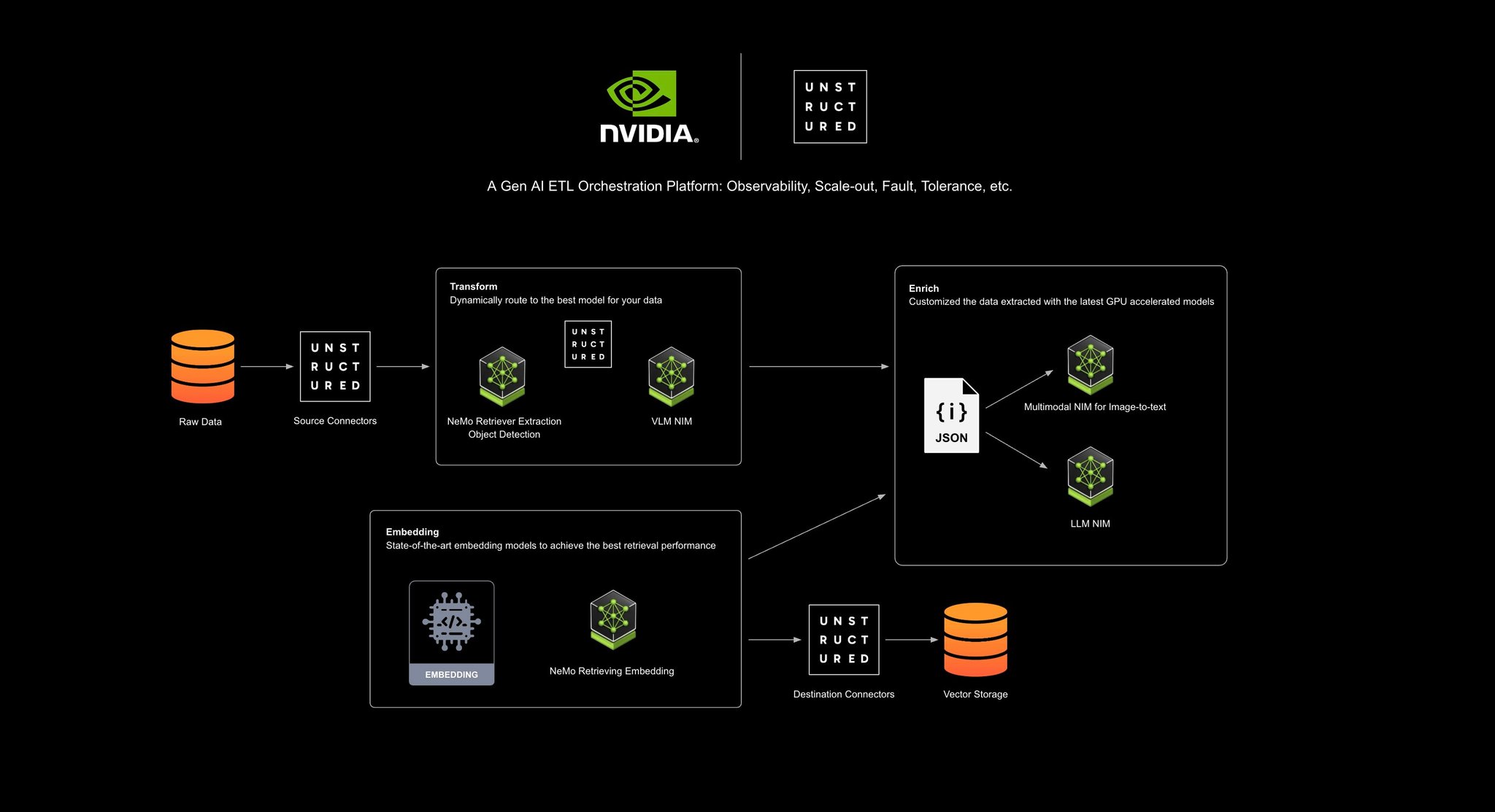
That structured content is then enriched with LLM- and VLM-based insights, embedded with high-performance models, and routed into vector databases, data warehouses, or other retrieval systems - all within a horizontally scalable, fault-tolerant pipeline that runs entirely on-prem.
Together with NVIDIA NeMo Retriever, Blackwell, and an ecosystem of validated partners, Unstructured helps form a complete, enterprise-grade stack for building sovereign, secure, and scalable AI. Whether you're deploying copilots, agents, or retrieval systems, this architecture ensures your unstructured data is AI-ready—without ever leaving your infrastructure.
Check out NVIDIA’s blog to learn more about NVIDIA Enterprise AI Factory validated design.
FAQ
How does Unstructured handle complex enterprise PDFs in an on-premises deployment?
Unstructured integrates with NVIDIA NeMo Retriever microservices to extract multimodal content, including text, tables, and charts, from complex enterprise PDFs at speeds up to 15x faster and with up to 50% fewer inaccuracies compared to standard approaches. The pipeline runs entirely on-premises, meaning sensitive documents never leave your infrastructure while still benefiting from production-grade extraction performance.
What data sources can Unstructured connect to when building an on-prem AI pipeline?
Unstructured automatically ingests unstructured content from enterprise systems including Salesforce, Amazon S3, and internal file shares. Once ingested, documents are parsed using native partitioning, OCR, and Vision-Language Models, then enriched with LLM-based insights and routed into downstream systems such as vector databases or data warehouses.
What is the NVIDIA Enterprise AI Factory validated design?
The NVIDIA Enterprise AI Factory validated design is a reference architecture from NVIDIA that provides guidance for deploying and managing agentic AI, physical AI, and HPC workloads on NVIDIA Blackwell hardware on-premises. It recommends specific combinations of accelerated computing, networking, storage, and software to reduce deployment risk and accelerate time-to-value for enterprise AI projects.
Why is data preprocessing a critical step before feeding documents into an AI model?
Raw enterprise documents contain inconsistent formatting, embedded images, complex tables, and noise that can degrade model performance if passed in directly. Preprocessing structures that content into clean, normalized inputs, which improves retrieval accuracy, reduces hallucinations, and ensures the model is working with high-quality data rather than raw file artifacts.
What makes on-premises AI deployments more challenging than cloud-based ones?
On-premises deployments require organizations to manage their own compute infrastructure, software integration, and pipeline orchestration without the abstraction layers that cloud platforms provide. The tradeoff is greater control over data governance, latency, and cost, but it demands more deliberate architectural decisions around hardware selection, data ingestion, and model serving.